CAMoRo: collaborative autonomous mobile robots
Demand for automation is growing fast in sectors such as logistics, industry, and healthcare, driven by ongoing labor shortages and the increasing complexity of operational processes. Interreg CAMoRo (Collaborative Autonomous Mobile Robots) responds to this by developing autonomous mobile robots (AMRs) that communicate with each other and coordinate their actions.
In this cross-border project, knowledge institutions, technology companies, and network organizations from the Netherlands and Flanders work together on a shared innovation: a platform that lets robots stop operating in isolation and instead collaborate efficiently within complex environments.
From isolated robots to smart collaboration
Today's AMR applications often lack coordination, which leads to inefficiency, congestion, and suboptimal deployment. CAMoRo addresses this by:
enabling real-time communication between robots,
supporting joint decision-making,
and letting robots collaborate flexibly in dynamic environments.
Validation across multiple sectors
The technology is validated in realistic applications, including:
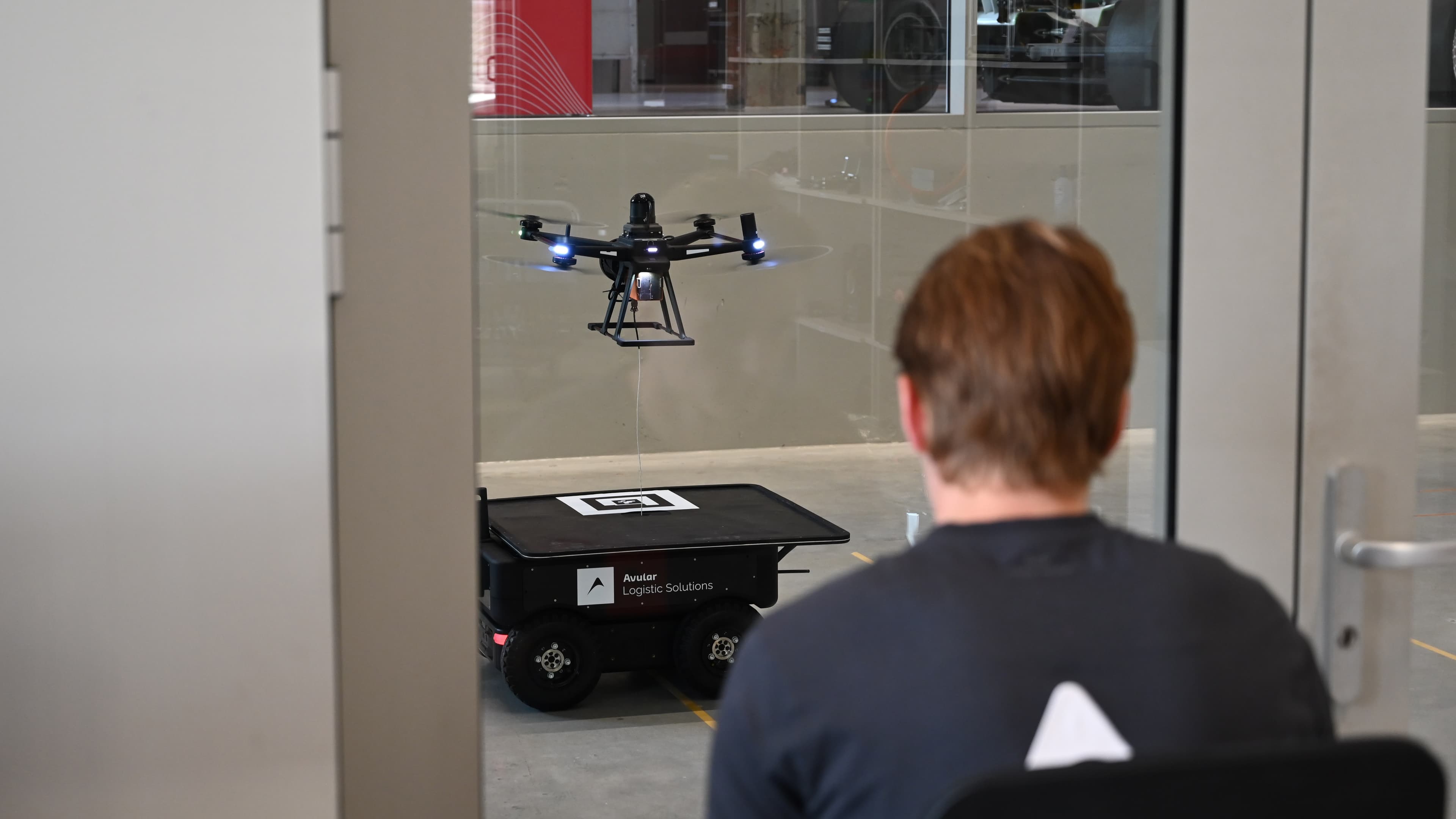
collaboration between robots and drones,
logistics optimization in warehouses,
safe interaction between robots and human operators,
and deployment in complex healthcare environments.
Cross-border impact
By combining expertise in robotics, AI, and communication technology, CAMoRo strengthens the innovative power of the Flemish-Dutch high-tech sector. The project contributes to:
higher productivity and efficiency,
better use of available personnel,
and faster adoption of robotics within SMEs and industry.
Project objectives
The main goal of CAMoRo is to strengthen the innovation and research capacity of the Flemish-Dutch border region by developing and applying collaborative autonomous mobile robots. The objectives are to:
develop a reliable platform for collaborative AMRs, covering communication, algorithms, and integration, aimed at scalable collaboration between robots;
improve efficiency and productivity in sectors such as logistics, industry, and healthcare through better coordination and task distribution;
strengthen cross-border R&D and collaboration between knowledge institutions and industry, with a focus on application by SMEs;
validate the technology in practice-oriented use cases, aimed at broad applicability and adoption across sectors;
accelerate market introduction and scale-up of robotics innovations through demonstrations, knowledge sharing, and network activation.
Partners
Project lead and sector connection
High Tech NL is the lead partner. It safeguards the project's substantive and financial progress and connects the consortium with companies and potential users across the wider high-tech sector.
Knowledge institutions
- Ghent University (IDLab) brings expertise in time-critical wireless communication, machine learning, sensor fusion, and multi-robot collaboration.
- Eindhoven University of Technology develops robust, efficient communication networks for stable and secure data exchange between autonomous robots.
- imec provides advanced test infrastructure and knowledge of industrial IoT, AI, and wireless networks for the development and validation of the technology.
Robotics companies
- Ambyon develops autonomous mobile robots for logistics tasks in hospitals, freeing care staff to focus on their core work.
- Avular Innovations develops mobile robot solutions for logistics and industrial applications, including in distribution centers and warehouses.
- Intermodalics develops real-time control and communication systems that let autonomous robots navigate and collaborate reliably.
- Zeal Robotics develops robotics solutions for logistics processes in warehouses and distribution centers, and demonstrates collaboration between multiple robots.
Technology integration partner
- WeNet translates the research results into a user-friendly, brand- and application-independent system that lets different autonomous robots communicate and collaborate.
Communication and network partners
- Agoria contributes its Flemish technology and industry network to share project results and involve companies and users in CAMoRo.
- Stichting Breda Robotics deploys its Dutch robotics network for communication, knowledge sharing, and connecting the project results to practice.